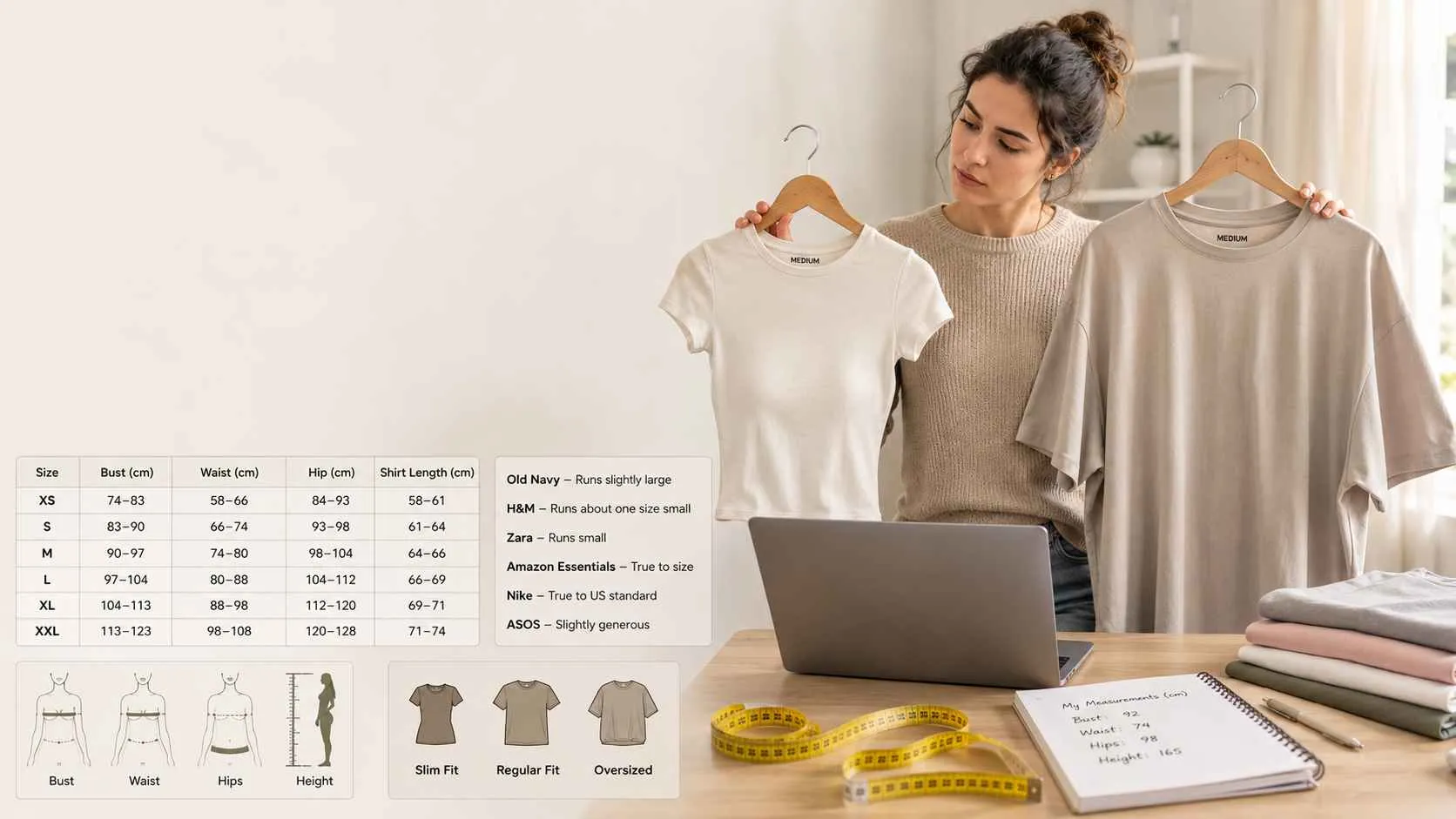
Quick Answer: A women’s t-shirt size chart in cm typically runs from XS (bust 74-83 cm) to XXL (113-123 cm). Most US brands measure bust, waist, and hip circumference in centimeters to match you to a size. Height and fit style also affect the final result.
I ordered a medium from two different websites last spring, in the same week. One fit like it was cut for me. The other one, also labeled medium, hung off my shoulders like a tent.
That is the reality of shopping for t-shirts online. There is no single “medium” that applies everywhere, and a t shirt size chart for female cm from one store rarely matches another store’s numbers exactly.
This guide breaks down what actually works: how to measure yourself correctly, what the standard cm ranges look like across US brands, and where most people go wrong.
I cross-checked these ranges against a dozen US retailers, including Old Navy, Target, and Amazon Essentials, among them, and the numbers below reflect what I actually found.
Please still check the exact chart for whatever you’re buying. But once you know your own numbers, matching them takes seconds instead of guesswork. For a broader overview, see our complete t-shirt size guide.
Why T-Shirt Sizes Vary So Much Between Brands
Every clothing brand builds its own size block. There is no single legal standard that forces a US retailer to use one universal set of numbers.
A brand targeting a younger, trend-driven customer often cuts its shirts smaller. A brand focused on everyday basics tends to run larger.
Fabric choice plays a role too. A shirt made from thick cotton fleece needs more room than a shirt made from a thin cotton-poly blend.
This is exactly why relying on your own body measurements, not just a size label, gives you the most reliable result across different stores.
T-Shirt Size Chart for Females — measured in centimetres
Sizing charts vary slightly between brands, but most US retailers follow a similar range. Use the table below as your baseline reference before you order.
Standard Body Measurements
| Size | Bust (cm) | Waist (cm) | Hip (cm) | Shirt Length (cm) |
|---|---|---|---|---|
| XS | 74–83 | 58–66 | 84–93 | 58–61 |
| S | 83–90 | 66–74 | 93–98 | 61–64 |
| M | 90–97 | 74–80 | 98–104 | 64–66 |
| L | 97–104 | 80–88 | 104–112 | 66–69 |
| XL | 104–113 | 88–98 | 112–120 | 69–71 |
| XXL | 113–123 | 98–108 | 120–128 | 71–74 |
Body vs. garment: These ranges reflect body measurements, not the flat garment itself. A shirt’s actual fabric width is usually a few centimetres wider to allow room for movement.
Brand variance: Brands like Nike and ASOS publish similar ranges, though exact numbers shift by a centimetre or two. Always check the specific brand’s chart before you order — especially near a size boundary.
How Sizing Really Differs by Brand
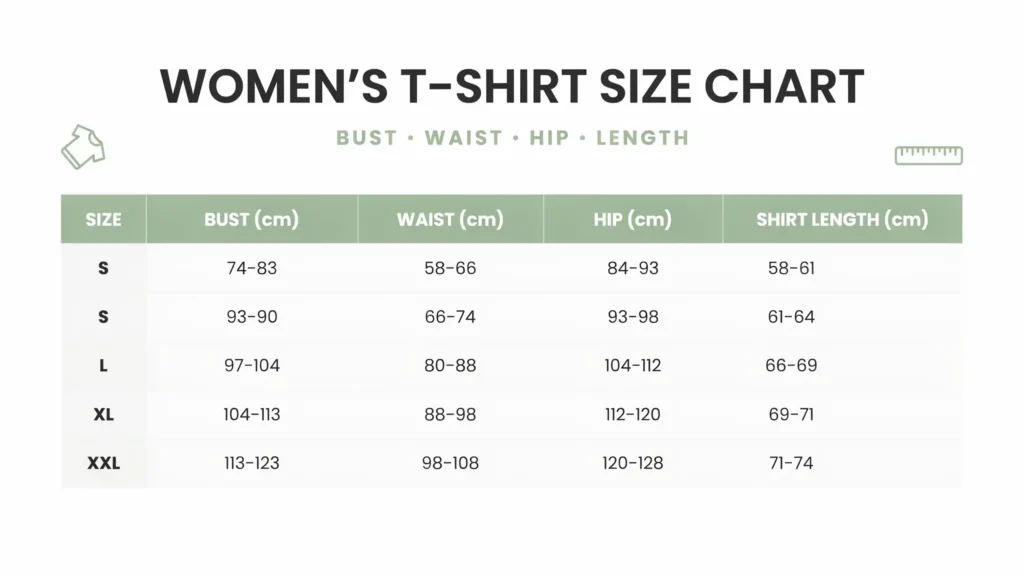
The chart above works as a baseline, but brands don’t all cut to the same numbers. A few patterns show up often enough to be worth knowing before you check out.
| Brand | Sizing Tendency | Tip |
|---|---|---|
| Old Navy | Runs slightly large | Size down if you’re between sizes |
| H&M | Runs about one size small | A US M often fits closer to their L |
| Zara | Runs small | Size up by one from your usual |
| Amazon Essentials | True to size | Use the chart above directly |
| Nike | True to US standard | Check the activity-specific fit notes |
| ASOS | Slightly generous | Order based on your actual measurements |
This is exactly why the same size label can feel completely different depending on where you shop. Your own bust, waist, and hip numbers stay constant; the brand’s interpretation of “medium” doesn’t.
I learned the Zara lesson the hard way. I ordered a size S last month, going by my usual US small at 83 cm bust — and it wouldn’t close. Their S runs closer to 79 cm. That one-size-up tip in the table above isn’t a guess. It’s the return label I still have sitting in my inbox.
How to Measure Your T-Shirt Size (Step-by-Step)
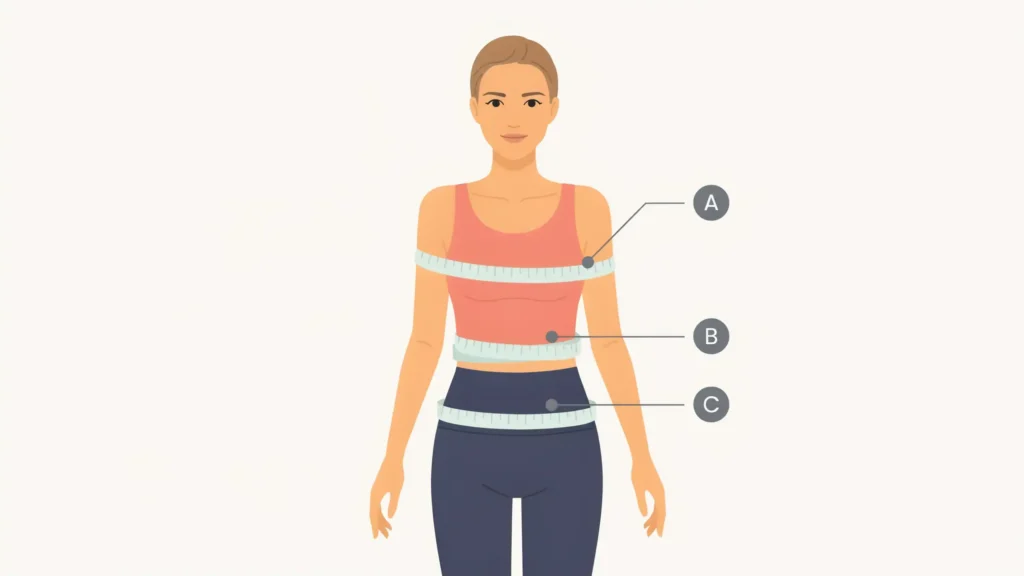
A tape measure and a couple of minutes will get you there. Skip the guesswork, and measure your actual body rather than an old shirt that has already stretched out of shape.
Stand the way you normally would; don’t suck your stomach in or push your chest out, since that changes the number. The tape should sit snug against your skin without leaving a mark behind.
How to Measure Bust Size in CM
Wrap the tape around the fullest part of your bust. Keep it level across your back, not angled up or down.
Breathe normally while you measure. Write down the number in centimeters. This becomes your primary reference point for choosing a size.
How to Measure Waist Size in CM
Find your natural waistline. This sits just above your belly button, at the narrowest point of your torso.
Wrap the tape around this point. Keep one finger between the tape and your skin so it does not pinch.
How to Measure Hip Size in CM
Stand with your feet together. Measure around the widest part of your hips and backside.
This is usually about 18-20 cm below your natural waistline. Many US shoppers skip this step, but it matters for fitted or bodycon-style t-shirts.
How to Measure Shoulder and Sleeve Length in CM
Shoulder width matters most for structured or fitted t-shirt styles. Measure from the edge of one shoulder seam straight across to the edge of the other.
For sleeve length, start at that same shoulder edge. Run the tape down the outside of your arm to wherever you want the sleeve to end.
These two measurements rarely change your overall size choice. They do help you judge whether a specific style will feel snug across the shoulders or loose through the arms.
How to Know Your T-Shirt Size Without a Measuring Tape
No tape measure at home? Grab a t-shirt that already fits you well.
Lay it flat on a table. Measure across the chest, from armpit seam to armpit seam, then double that number. This gives you a rough bust measurement.
Do the same from the shoulder seam down to the hem for length. Compare these numbers against the brand’s product-specific measurements, which usually appear on the item page.
This method works best as a backup. A direct body measurement still gives the most accurate result for a t shirt size chart for female cm.
T-Shirt Size Chart for Female Height (CM)
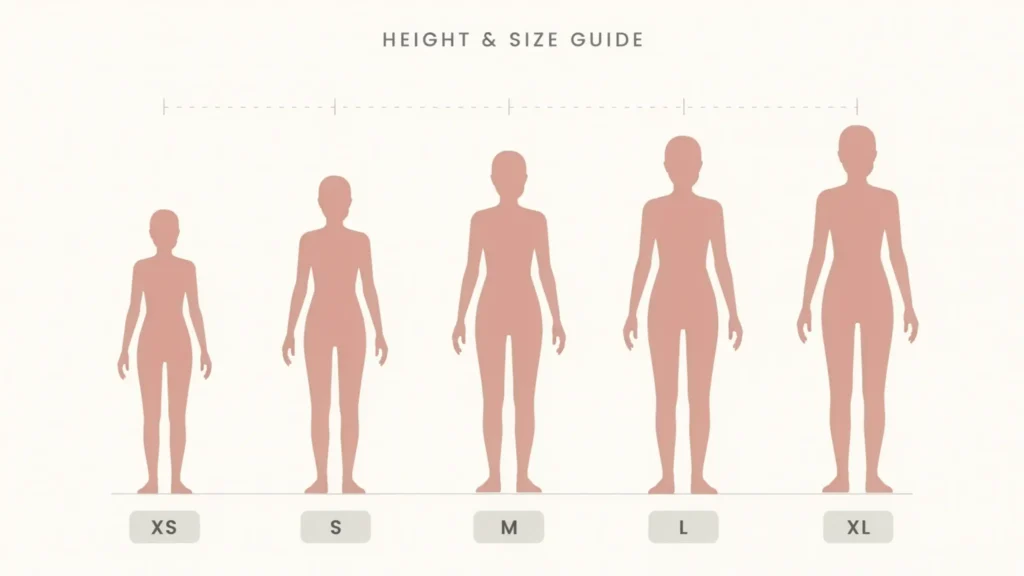
Height alone will not tell you your exact size. It does help narrow down proportions, especially for shirt length and sleeve fit.
| Height Range (cm) | Common Size Tendency |
|---|---|
| 150–158 | XS–S (petite proportions) |
| 159–165 | S–M |
| 166–172 | M–L |
| 173–178 | L–XL |
| 179+ | XL–XXL or tall-fit styles |
Treat this table as a starting point, not a final answer. I’m 5’6″ and the M-L range fits me depending on the brand — this table just keeps you from going in completely blind.
Still Thinking in Inches? Here’s the Fast Math
Some US shoppers still think in inches, even when a chart lists centimeters. The math isn’t complicated — divide the cm number by 2.54, and you’re there.
So 90 cm becomes roughly 35.4 inches. A 66 cm waist becomes about 26 inches. Round to the nearest half-inch, and you’re close enough for any US size chart.
I still do this math on my phone’s calculator every time I shop from a UK site. It beats opening five browser tabs to cross-check numbers.
US to UK and EU T-Shirt Size Conversion
Shopping from a UK or European retailer adds another layer of confusion. Their numeric sizing does not match US letter sizing directly.
| US Size | UK Size | EU Size |
|---|---|---|
| XS (0-2) | 4-6 | 32-34 |
| S (4-6) | 8-10 | 36-38 |
| M (8-10) | 12-14 | 40-42 |
| L (12-14) | 16-18 | 44-46 |
| XL (16-18) | 20-22 | 48-50 |
| XXL (20-22) | 24-26 | 52-54 |
Keep in mind that this table offers a general reference only. Always cross-check against the specific retailer’s own chart, since even UK and EU brands differ from each other by a size or two.
Common Mistakes to Avoid When Measuring Your Size
Wearing a bulky sweater while you measure throws off every number. Always measure over thin clothing or, ideally, directly against your skin.
Pulling the tape too tight is another frequent error. This makes your measurements smaller than reality, and the shirt you order will feel snug.
Standing with poor posture also skews results. Stand tall, relax your shoulders, and keep your arms at your sides during each measurement.
Rushing through the process causes the most mistakes overall. Take thirty extra seconds, double-check each number, and your order will fit the first time.
Ignoring the brand’s specific chart is another common slip. A universal reference like this one helps you estimate, but the exact retailer’s numbers always take priority at checkout.
Forgetting about seasonal layering also trips up many shoppers. If you plan to wear the shirt over a bra with padding or under a jacket, consider sizing up slightly for comfort.
How to Choose a Size When Buying a T-Shirt as a Gift
Buying a t-shirt for someone else removes the option of measuring them directly. A few smart questions can still get you close to the right size.
Ask what size they usually wear at a specific store you both know, like Old Navy or Target. This gives you a real reference point instead of a random guess.
Check their closet for a similar t-shirt if you can, and note the size tag inside. Match that tag against the brand’s chart you plan to order from.
When in doubt, size up. A slightly loose t-shirt still gets worn. A shirt that is too tight often ends up in a donation pile.
How Fit Style Changes Your T-Shirt Size (Slim, Regular, Oversized)
Two shirts can share the same size label yet fit completely differently. The reason comes down to fit style, not just body measurements.
A slim-fit tee sits close to the body. Brands cut these shirts with less ease, so many shoppers size up if they want a relaxed feel.
A regular-fit tee follows the standard chart numbers fairly closely. This is the safest choice if you are unsure which style to pick.
An oversized or relaxed-fit tee adds several extra centimeters of room. Many shoppers intentionally size down for this style to avoid a boxy, shapeless look.
Always check the product description for fit type before you rely only on the size chart. This one detail changes how the same size number feels on your body.
How Fabric Affects Your Final Fit
Cotton shirts tend to shrink slightly after the first wash, sometimes by one to two centimeters. A cotton-spandex blend holds its shape better and stretches to move with your body.
If you buy 100% cotton, consider sizing up slightly, especially if you plan to wash it in hot water. A blend with even 5% elastane forgives small sizing mistakes far more easily than pure cotton does.
Ribbed cotton tees also fit tighter than standard jersey knit, even at the same listed size. Check the fabric composition on the product page before you finalize your choice.
Which Fit Suits Your Body Type
The right size number still needs the right cut to actually look and feel good. A few quick pointers by body type can save you a return.
Petite frames (under 163 cm) usually do better in shorter shirt lengths and cropped or boxy cuts. A regular-length tee can swallow a smaller frame and make you look shorter than you are.
Curvy or fuller-busted figures tend to feel most comfortable in a semi-fitted or relaxed cut through the body, with enough room across the bust to avoid pulling at the buttons or seams.
Tall frames (over 173 cm) often need an elongated body length and slightly longer sleeves. Standard-length tees can ride up and leave a gap at the waist during the day.
Athletic or straight builds generally have the most flexibility, since most standard charts are built around this body type. Slim-fit and regular-fit styles both tend to work well.
None of this replaces measuring yourself first. It just helps you pick the right style once you already know your size.
Plus Size and Petite T-Shirt Size Charts (CM)
Plus-size charts typically start where standard charts end, often around 113 cm bust and above. Brands like Nike extend their range up to a 4X, covering roughly 140–147 cm in bust measurement.
Petite charts shorten the body length and sleeve length while keeping similar bust and waist ranges. This suits shoppers under about 163 cm in height.
If you fall between a standard and- or petite-specific chart, read the brand’s fit notes closely. Some brands design plus sizes with proportionally wider shoulders, not just a wider torso.
Frequently Asked Questions
A few questions come up again and again in the comments and reviews sections of size charts. Here’s what shoppers usually want to know.
How to measure women’s t-shirt size?
Wrap a tape measure around the fullest part of your bust, keeping it level across your back. Then measure your natural waistline and the widest part of your hips. Match all three numbers against a size chart in centimeters, not just one measurement alone.
What size is M in ladies?
A ladies’ medium typically falls between 90-97 cm bust, 74-80 cm waist, and 98-104 cm hip. In inches, that’s roughly 35-38 inches around the bust. Exact numbers shift slightly by brand, so always check the specific retailer’s chart near a size boundary.
Is 36 size S or XS?
A 36-inch bust converts to about 91 cm, which lands right at the small-to-medium boundary on most US charts. Some brands still list it as a large small, while others already count it as a medium. Check the brand’s own chart if you’re close to this number.
What’s my shirt size for females?
Measure your bust, waist, and hip in centimeters, then compare all three against the brand’s size chart. Your bust measurement usually carries the most weight, but hip size matters too for fitted or bodycon-style shirts.
Is 32 size S or M?
A 32-inch bust converts to about 81 cm, which typically falls in the extra-small to small range on most US charts. It rarely reaches a medium, unless the brand runs unusually small for its labeled sizes.
How do I decide my t-shirt size?
Start with your bust measurement in centimeters, since most brands build their charts around it. Cross-check your waist and hip too, and lean toward the larger size if your numbers fall between two ranges. Fit style also matters — size down for oversized cuts, size up for slim-fit ones.
What size is a medium in a t shirt size chart for female cm?
A medium typically falls between 90-97 cm bust, 74-80 cm waist, and 98-104 cm hip. Exact numbers shift slightly by brand, so treat this as a starting point.
How do I know my t-shirt size in cm without shopping in person?
Measure your bust, waist, and hip with a tape measure, then match the numbers against the brand’s specific size chart before checkout. It takes less time than reading five customer reviews arguing about fit — and those reviews are usually from people who didn’t measure either.
Is a small size the same across every US brand?
Not even close. A small at one brand might equal 83 cm bust, while another brand lists 86 cm for the same label. Always check the item-specific chart, not just the brand’s general one.
Do t-shirt size charts include the fabric or just body measurements?
Most charts list body measurements, not the flat garment itself. The actual shirt gets cut a few centimeters larger to leave room for movement, which is why “flat measurement” charts can be misleading if you don’t know the difference.
Should I round up or down when I fall between two sizes?
Round up if you want a relaxed, comfortable fit. Round down only if you genuinely prefer a fitted, closer-to-body look and don’t mind less breathing room.
How accurate are online t-shirt size charts compared to trying items on in-store?
Charts are generally reliable within a centimeter or two, provided you measure your body correctly. In-store try-ons still remove all guesswork, especially for fitted styles.
Why does the same size feel different in a t-shirt versus a dress?
T-shirts and dresses use separate size blocks built around different fit goals. A brand’s dress sizing rarely maps directly onto its t-shirt sizing, even under the same label.
Final Thoughts on Choosing the Right Fit
Sizing charts will never be perfectly identical across every brand. That’s just the reality of buying clothes online in 2026, even with better standardization efforts across the industry.
Once you know your own bust, waist, and hip measurements in centimeters, though, comparing them against any chart takes seconds not the fifteen minutes I used to waste second-guessing myself before returns became a habit.
Keep your measurements saved on your phone. Pull them up any time you shop, and you will pick the right size on the first try, every time.
Sizing standards continue to shift each year slightly as brands update their cuts and fit models. Check back on this guide occasionally, and always confirm against the current chart listed on the product page before you check out.

I'm Habib founder of Goku Fashion Outfit Style and a boutique owner with over 10 years in the fashion industry. I've styled thousands of real clients, run a fashion business from the ground up, and now I'm sharing everything I know through this blog. My goal is simple: help you dress better, shop smarter, and understand fashion in a way that actually makes sense for your life.
- Habib

- Habib
- Habib
- Habib