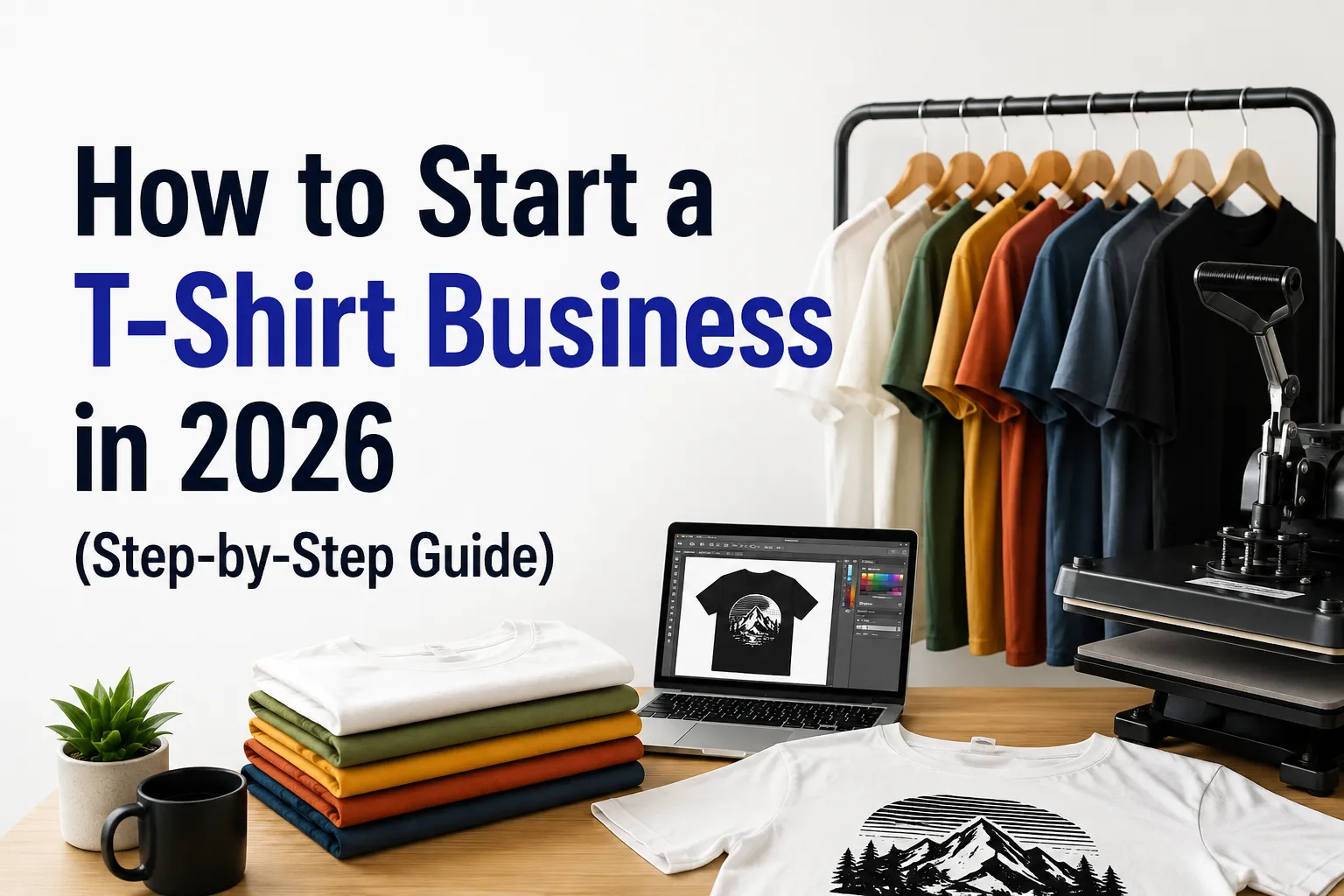
Starting a t-shirt business sounds simple: pick a design, print it, sell it. But most people get stuck before they make their first sale, not because their designs are bad, but because nobody told them the real numbers, the real steps, or the real mistakes to avoid.
I’ve seen this firsthand after 10 years of running a boutique. The gap between “I have a great idea” and “I have a profitable business” is almost always a matter of information, not talent.
This guide fills that gap. I made every mistake in the book when I started. I underpriced my first batch, chose the wrong printing method for my design style, and almost trademarked the wrong thing.
Ten years and hundreds of orders later, I built this guide around what I wish someone had told me on day one. You’ll get exact startup costs, an honest comparison of every printing method, a neutral platform breakdown, and the legal protection steps most guides skip entirely.
Whether you’re starting from zero dollars or have a small budget, by the end, you’ll know exactly which model fits your situation and how to move forward today.
Key Takeaways
- $0 start is possible with print on demand, no inventory, no equipment
- DTG printing costs $5–15 per shirt to produce
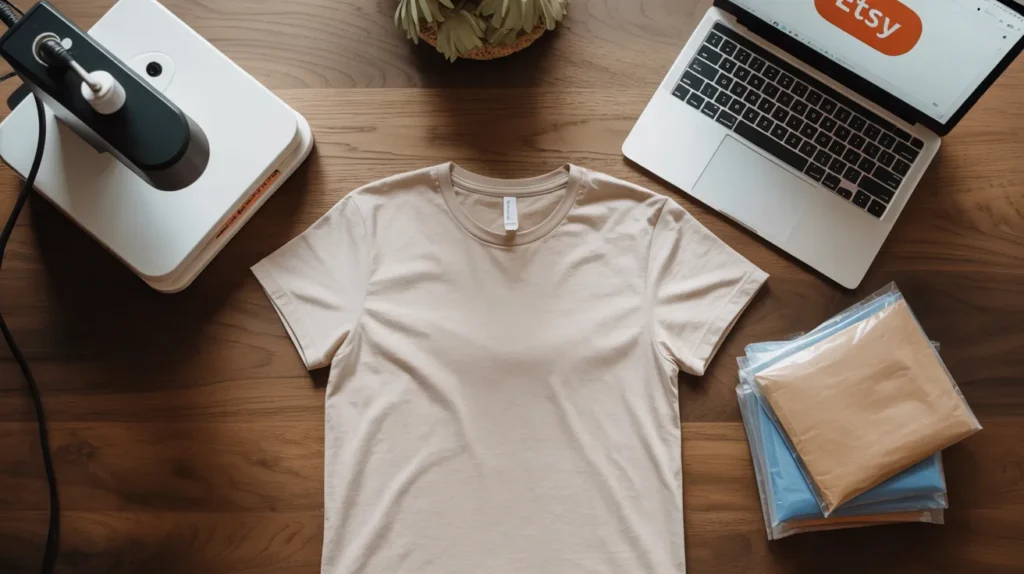
- Heat press machine costs $200–600 for a home setup
- Shopify is best for brand building; Etsy is best for organic discovery
- Trademark registration costs $250–350 per class at the USPTO
- Poly mailer size for t-shirts: 10×13 inches fits most adult tees
Is a T-Shirt Business Actually Profitable? (Honest Answer)
The custom apparel market is worth over $9 billion and growing at 11.5% annually. That’s not a vanity stat, it means real buyers are spending real money on t-shirts every day.
The question isn’t whether the market exists. It’s whether your slice of it can generate a meaningful profit margin. Here’s the honest math.
A blank Bella + Canvas tee costs around $4–6 wholesale. DTG printing adds $5–15. Your retail price should be $25–35. That’s a 40–60% gross margin, healthy for any product business.
Screen printing significantly lowers your per-unit cost for bulk orders, pushing margins even higher. The business is profitable when you control your costs and price correctly from day one.
The most common mistake beginners make is underpricing. They see competitors at $20 and race to the bottom. Don’t. Your pricing strategy should reflect quality, brand, and positioning, not just what someone else charges.
In my first year, I sold shirts at $18 because I thought that’s what customers wanted. I was wrong. When I raised my price to $28 and improved my packaging, sales actually went up. Customers read price as quality, especially on apparel.
Step 1: Choose Your Business Model First
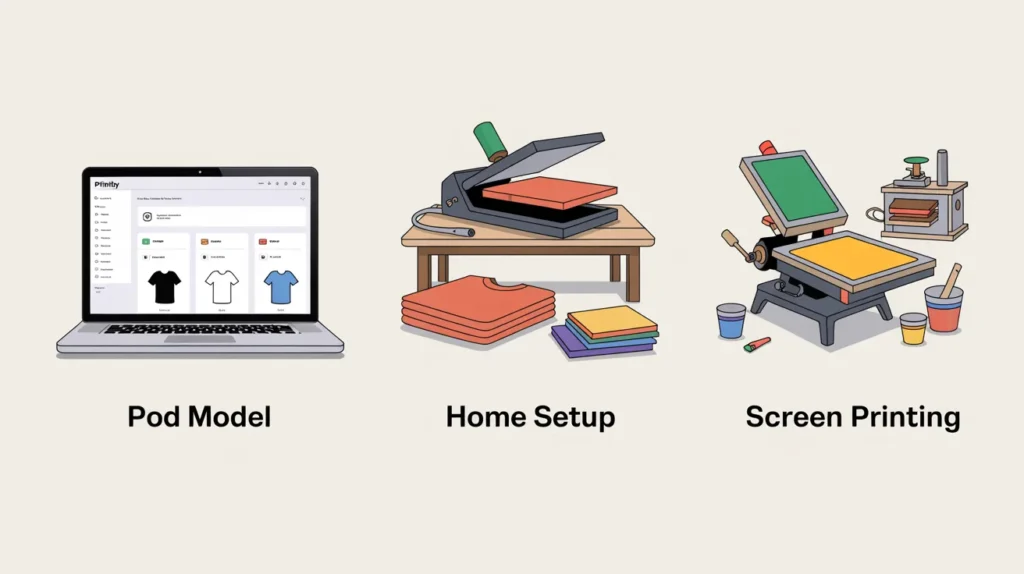
$0 Model: Print on Demand
Print on demand (POD) is the only model that requires zero upfront investment. Platforms like Printify and Printful print and ship each order directly to your customer. You never touch inventory. Your job is design and marketing.
Real numbers: Printify charges $8–12 per shirt. You sell at $28–35. Profit per sale: $16–23 minus platform fees. It’s lower margin than owning your printing, but the startup cost is genuinely zero. This is how to start a t-shirt business with no money, and it works.
I tested POD for three months before investing in equipment. It validated my designs with zero risk. Two designs sold consistently, and those are the ones I then moved to screen printing for better margins.
$200–600 Model: Home Setup
A heat press machine ($200–400) plus blank tees ($3–6 each) plus heat transfer vinyl ($30–50) gives you a complete home printing setup for under $600.
You control quality, turnaround time, and customization. This is the sweet spot for home-based business owners who want more control than POD without a massive investment.
$2,000+ Model: Physical or Screen Print Setup
Screen printing equipment starts around $1,500–3,000 for a basic manual setup. Add blanks inventory, inks, and emulsion, and you’re at $2,500–4,000 to start.
The per-unit cost drops dramatically at volume $1–3 per print at 50+ pieces. This model makes sense when you have consistent bulk orders or a physical storefront.
Step 2: Pick Your Niche
Trying to sell t-shirts to everyone is the fastest way to sell to no one. Niche selection is the single most important decision you’ll make. The more specific your audience, the easier marketing becomes.
Strong trending t-shirt niches in 2026 include profession-based designs (nurses, teachers, electricians), pet lover graphics, cause-based messaging, local pride, and humor niches.
Evergreen t-shirt niche ideas that never go out of demand include faith, family, and fitness. Each of these has a passionate target audience that buys repeatedly and shares organically.
Use Google Trends and keyword research to validate before you invest. Search for your niche idea and check if volume is growing, stable, or declining. A growing niche with a passionate community and low competition is your ideal entry point.
Step 3: Printing Methods Compared
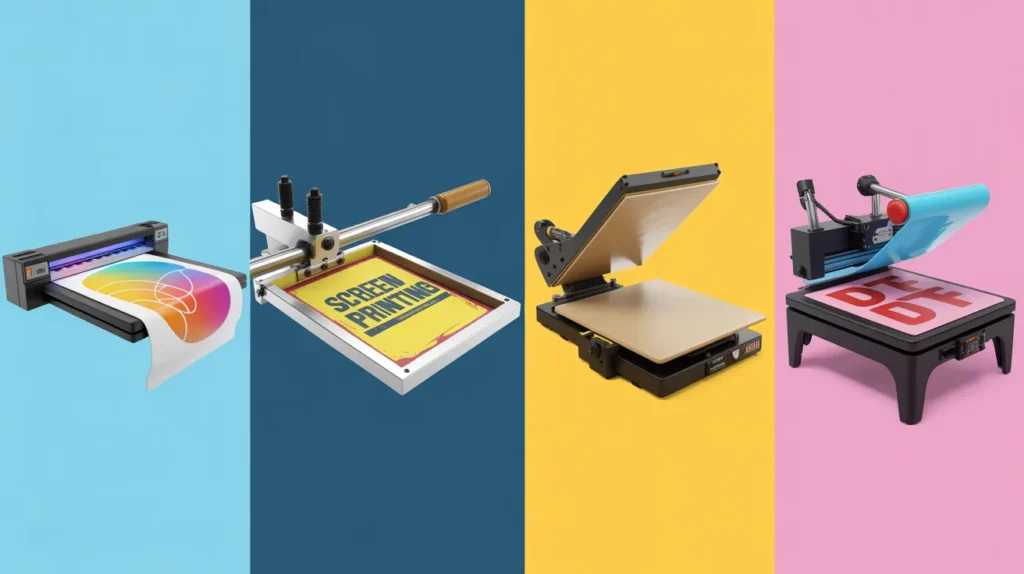
This is the table every competitor skipped. Here’s an honest breakdown:
| Method | Cost Per Shirt | Min Order | Best For | Quality |
|---|---|---|---|---|
| DTG Printing | $5–15 | 1 piece | Complex designs, small runs | Excellent on cotton |
| Screen Printing | $1–4 | 24–50 pieces | Simple designs, bulk orders | Best overall durability |
| Heat Transfer | $2–6 | 1 piece | Home setup, customization | Good if applied correctly |
| DTF Printing | $3–8 | 1 piece | Dark shirts, detailed art | Very good, growing fast |
| Sublimation | $2–5 | 1 piece | Polyester only, all-over print | Vibrant, permanent |
| Print on Demand | $8–15 | 1 piece | Zero inventory model | Varies by supplier |
DTG printing wins for quality on small runs. Screen printing wins on cost for bulk. Heat transfer wins for home-based flexibility. DTF printing is the fastest-growing method in 2026, excellent on dark shirts with no minimum order.
Personal note: In my boutique, I started with heat transfer vinyl on a $250 press from Amazon. It worked fine for small custom orders. Once I hit consistent 50-piece orders for the same design, I switched to screen printing. Cost per unit dropped from $6 to $2.40. That single switch added $180 profit per batch without changing anything else.
Step 4: Real Startup Costs Breakdown
Nobody gives exact numbers. Here they are:
Print on Demand ($0–100):
- Printify/Printful account: Free
- Shopify or Etsy store: $0–29/month
- Basic design tool (Canva): Free
- Sample orders to check quality: $50–100
Home Heat Press Setup ($400–800):
- Heat press machine: $200–400
- Starter blank tees (24 pieces): $80–120
- Heat transfer vinyl + designs: $50–80
- Shipping supplies (poly mailers, tape): $30–50
- Business registration: $50–150
Small Screen Print Setup ($2,500–5,000):
- Manual screen printing press: $400–800
- Flash dryer or conveyor dryer: $300–800
- Screens, squeegees, inks: $200–400
- Exposure unit: $300–600
- Blank inventory (100 pieces): $300–500
- Everything else: $500–1,000
How much does it cost to make a t-shirt? Realistically: $4–18 depending on method, quantity, and blank quality. At scale, $4–8 per unit is achievable.
Step 5: Design, Branding, and Pricing
Your brand identity is what separates a forgettable tee from one people wear proudly and talk about. Start with a clear brand name, a consistent color palette, and a logo that works at small sizes. Canva handles basic design well for free. Adobe Illustrator is the industry standard for professional vector work.
For t-shirt design, think about what your target customer already wants to say your design is their voice. The best graphic tees don’t just look good; they communicate something the wearer believes. Research what’s selling on Etsy and Amazon, identify patterns, then bring your own angle.
Pricing strategy: Take your total production cost (blank + print + packaging + shipping supplies), multiply by 2.5 to 3x for online retail. A shirt costing $10 all-in should sell for $25–30.
This covers platform fees, ad spend, and still leaves a healthy margin. For how much to charge for t-shirt design work, freelance design rates run $25–150 per design, depending on complexity.
My biggest early branding mistake was using three different fonts across my first collection. It looked amateurish. One font family, two weights maximum, that’s the rule I follow now, and every collection looks intentional.
Step 6: Where to Sell Platform Honest Comparison
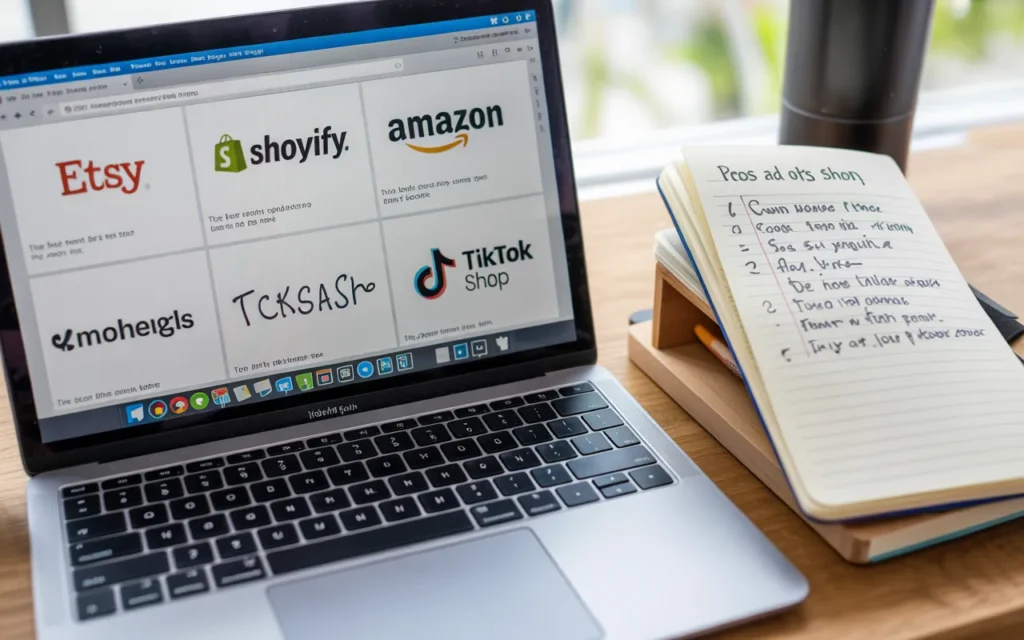
No platform bias here, each has real strengths and weaknesses:
| Platform | Best For | Monthly Cost | Traffic | Control |
|---|---|---|---|---|
| Etsy | Organic discovery, handmade feel | $0.20/listing | Built-in | Low |
| Shopify | Brand building, scaling | $29–79 | You build it | High |
| Amazon/Merch | Massive reach, passive | Free (approval needed) | Massive | Very Low |
| WooCommerce | Tech-savvy, full control | Hosting ~$10 | You build it | Full |
| TikTok Shop | Viral potential, Gen Z | Free | Growing fast | Medium |
How to sell t-shirts on Etsy is the easiest starting point, with built-in search traffic, a low barrier to entry, and buyers already looking for unique designs.
How to sell t-shirts on Shopify makes more sense once you have proven designs and want to build a real brand with email marketing and repeat customers.
Real talk: Start on Etsy to validate. Move to Shopify to scale. Run both together once you have consistent sales.
Step 7: Shipping, Packaging, and Display Setup
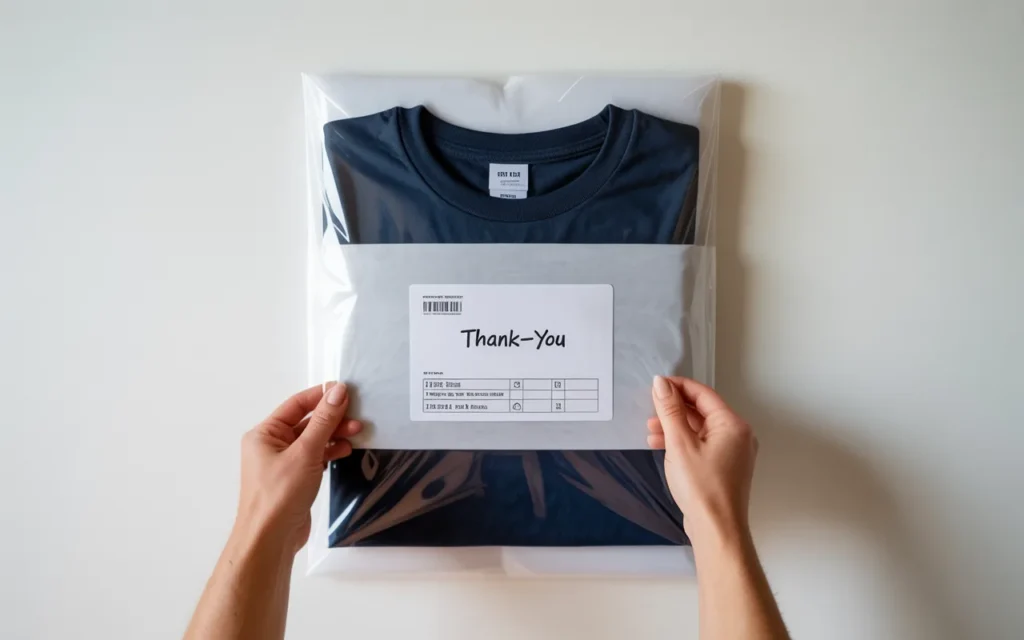
How much does it cost to ship a t-shirt? USPS First Class: $3.50–5.00 for a single tee under 1lb. Priority Mail: $7–9. Poly mailers are your best friend for cost and protection.
What size poly mailer for a t-shirt? A 10×13-inch poly mailer fits most folded adult t-shirts perfectly. For oversized or multiple shirts, go 12×15 or 14×17. Buy in bulk poly mailers cost $0.15–0.30 each at volume, which keeps your shipping cost low.
For physical retail or markets, how to display t-shirts for sale matters as much as the designs themselves. A basic gridwall setup ($80–150) with proper lighting converts browsers into buyers. We have a complete display guide linked below.
Pro tip: I added handwritten thank-you cards to every order for my first six months. Of my first 50 customers, 11 left reviews mentioning the card specifically.
Four became repeat buyers within 60 days. A $0.10 card generating a $28 repeat purchase is the best ROI I’ve found in this business. The ROI is enormous.
Step 8: Legal Protection
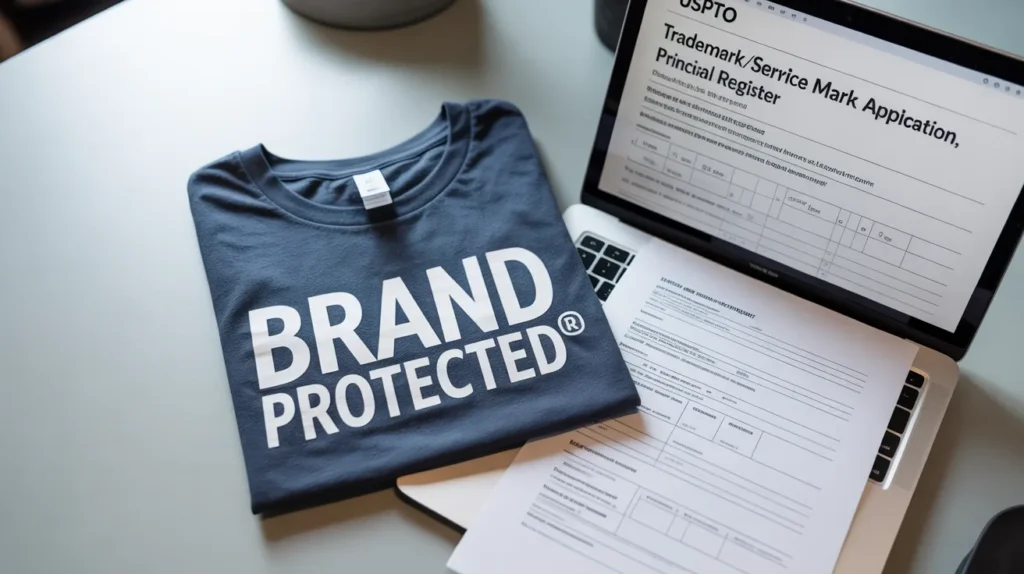
This is the section every competitor skipped, and it’s one of the most searched topics by new t-shirt business owners.
Copyright protects your original design automatically from creation. No registration needed, but registering with the US Copyright Office ($45–65) gives you the ability to sue for damages.
Trademark registration protects your brand name, logo, and phrases. T-shirts fall under Class 25 at the USPTO. Filing costs $250–350 per class. The process takes 6–9 months if your application is clean.
How to patent a phrase for a t-shirt: technically, you can’t patent a phrase. Patents protect inventions. What you actually need is a trademark.
File through USPTO’s TESS system, prove you’re using the phrase in commerce (on a tag or label, not just decoration), and you’ll have legal protection to stop copycats. We have a complete guide on this linked below.
Business license requirements vary by state. Most home-based t-shirt businesses need a basic business license ($50–150) and a resale certificate to buy blanks tax-free from wholesalers. LLC formation costs $50–500, depending on your state, and protects your personal assets.
Step 9: Marketing Your T-Shirt Business
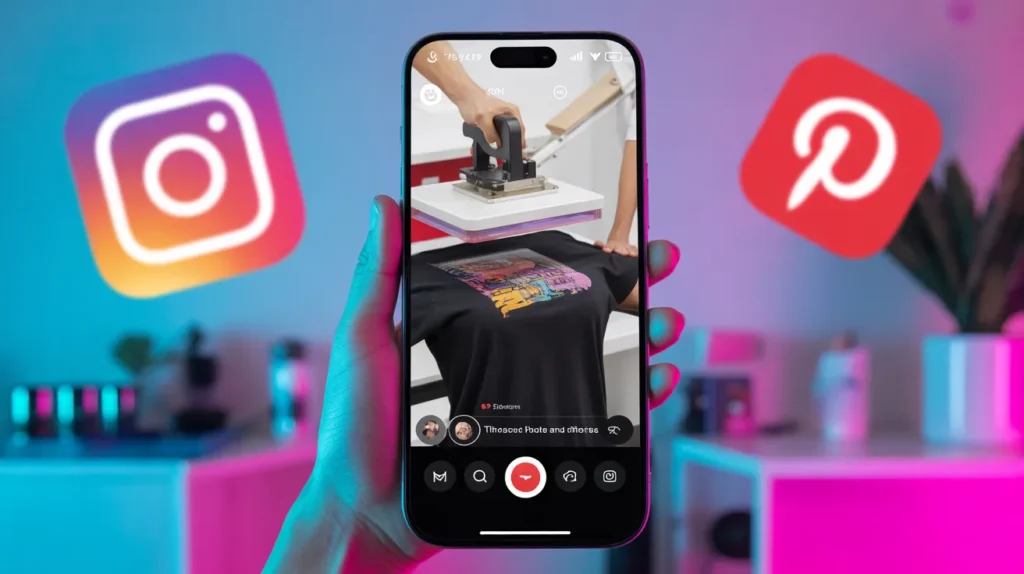
Social media marketing is your lowest-cost customer acquisition channel. Instagram marketing works best for lifestyle and aesthetic brands to post products to people, not just flat lays. TikTok shop is the fastest-growing channel for apparel in 2026, and behind-the-scenes printing videos get massive organic reach.
Pinterest marketing for t-shirt business is underused and incredibly effective pins have a long shelf life and drive consistent organic traffic.
Create boards by niche, design theme, and occasion. Email marketing builds your most valuable asset, a list of buyers you can reach without paying for ads every time.
Facebook ads work well for t-shirt businesses once you have a proven product. Start with $10–20/day, testing different audiences and creatives. Scale what works.
Influencer marketing at the micro level ($50–200 for a post from a 10k-50k account) often outperforms celebrity placements for niche products.
From my experience: My first 10 sales took three weeks, and most came from people I personally messaged. That felt humbling. But those 10 orders generated 6 reviews, and the next 10 sales came without any outreach at all. Social proof is slow to build and fast to compound just survive long enough to get it.
Step 10: Scale and Grow
Once you have consistent sales, how to scale t-shirt business comes down to systems. Automate order fulfillment where possible. Batch your printing days. Build an email list that you own, not just social followers.
Upsell and cross-sell t-shirts with bundle deals (“Any 2 for $40”), seasonal collections, and loyalty programs. T-shirt bundle deal strategy increases average order value without increasing customer acquisition cost. A customer buying two shirts is twice as valuable as one buying one, and they’re already at checkout.
Track the sell-through rate, conversion rate, and cost per acquisition weekly. Make one change at a time, measure it for a week, then decide. This discipline separates businesses that plateau from those that reach six-figure business revenue.
Conclusion
Starting a t-shirt business in 2026 is genuinely accessible; the tools, platforms, and information have never been better. The key is choosing the right business model for your budget, picking a specific niche with real demand, and understanding your production cost and profit margin before you spend a single dollar on marketing.
Whether you go with print on demand through Printify or Printful, set up a home heat press machine, or invest in screen printing equipment, the path forward is clear when you have real numbers to work with.
Protect your brand early with trademark registration, display and ship your product professionally, and market consistently across the channels where your target audience actually spends time.
The t-shirt business rewards those who start simple, validate fast, and scale what works. Your first sale is closer than you think.
FAQ
How much does it cost to start a t-shirt business?
As little as $0 with print on demand, or $400–800 for a home heat press setup. A full-screen printing operation starts at $2,500–5,000.
Can I start a t-shirt business from home?
Yes. A heat press, blank tees, and an Etsy or Shopify store is everything you need to start from home today.
How much profit can you make selling t-shirts?
Typically $8–20 per shirt, depending on your model. At 100 shirts per month, that’s $800–2,000 profit. At 500 shirts, $4,000–10,000.
What’s the best platform to sell t-shirts online?
Etsy for starting. Shopify for scaling. Merch by Amazon for passive income. Use all three once you’re established.
Do I need a business license to sell t-shirts?
Yes, in most US states. A basic business license costs $50–150, and a resale certificate lets you buy blanks tax-free.
What are the best blank t-shirts for printing?
Bella + Canvas 3001, Gildan 64000, and Next Level 3600 are the top choices. Comfort Colors 1717 is best for vintage/washed looks.
How long does it take to start making money?
With POD and Etsy, your first sale can come within 2–4 weeks if your listings are optimized. Consistent income typically takes 3–6 months.
How do I protect my t-shirt designs legally?
Copyright protects designs automatically. A trademark protects your brand name and phrases filed with the USPTO under Class 25.
What size poly mailer should I use for t-shirts?
10×13 inches for single adult tees. 12×15 for multiple shirts or bulkier items.
Is print-on-demand worth it?
Yes, for testing and starting. Margins are lower, but risk is zero. Transition to owned printing once you have proven sellers.

I'm Habib founder of Goku Fashion Outfit Style and a boutique owner with over 10 years in the fashion industry. I've styled thousands of real clients, run a fashion business from the ground up, and now I'm sharing everything I know through this blog. My goal is simple: help you dress better, shop smarter, and understand fashion in a way that actually makes sense for your life.
- Habib

- Habib
- Habib
- Habib